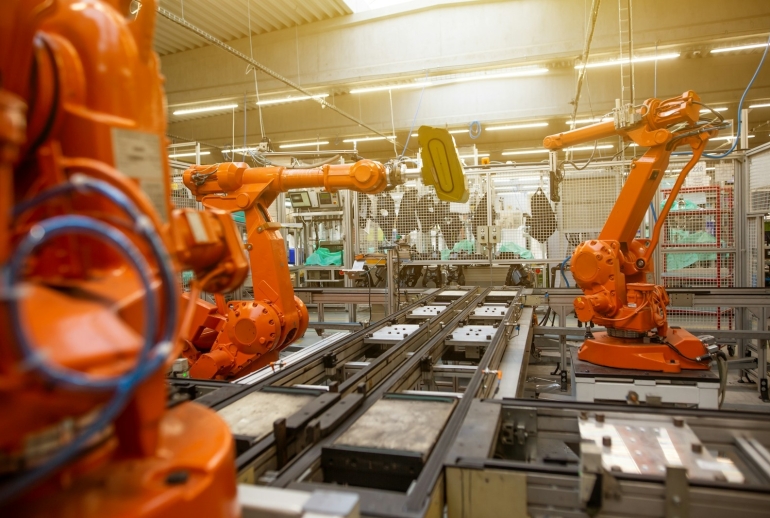
AI training for manufacturing companies in Malaysia equips production, quality, and engineering teams with practical generative AI and machine-learning skills they can apply on the factory floor — from predictive maintenance to automated quality inspection. Dr Muhamad Hariz Muhamad Adnan (drhariz.com), an HRD Corp certified AI trainer and Senior Lecturer at Universiti Pendidikan Sultan Idris (UPSI), delivers this kind of AI training across Malaysia in Bahasa Melayu or English. The most effective programmes in 2026 are hands-on, industry-specific, and HRD Corp claimable, meaning eligible employers can recover the cost through their HRD Corp levy. For manufacturers weighing this investment, the fastest path to results is a trainer who understands both the technology and the realities of Malaysian plant operations.
Why manufacturing is Malaysia’s biggest AI training opportunity
Manufacturing contributes roughly a quarter of Malaysia’s GDP and employs hundreds of thousands of workers across electrical and electronics (E&E), automotive, food processing, and machinery. Yet adoption of artificial intelligence on the shop floor remains uneven. Larger multinationals in Penang and the Klang Valley have begun deploying computer vision and predictive analytics, while many local small and medium manufacturers still rely on manual inspection and reactive maintenance. Structured AI training closes that gap by turning existing engineers, supervisors, and operators into confident users of AI tools — without needing to hire scarce data scientists.
Generative AI — systems that can produce text, images, or code from natural-language prompts — has lowered the barrier further. A production planner can now draft a shift report, summarise a defect log, or interrogate machine data using plain-English prompts, provided they have been trained to do so responsibly.
High-value AI use cases on the Malaysian factory floor
Predictive maintenance
Machine-learning models trained on sensor data (vibration, temperature, current draw) flag equipment likely to fail before it does, reducing unplanned downtime. Training teaches maintenance teams how to frame the problem, interpret model outputs, and act on them.
Automated quality inspection
Computer-vision systems detect surface defects, missing components, and misalignment faster and more consistently than manual checks. AI training helps quality engineers understand model limits, labelling requirements, and when human review is still essential.
Production planning and demand forecasting
AI-assisted forecasting improves inventory and scheduling decisions. Trained planners learn to combine AI outputs with domain judgement rather than treating predictions as absolute.
Generative AI for documentation and reporting
Standard operating procedures, safety briefings, audit reports, and supplier emails can be drafted far faster with generative AI. This is often the quickest win — high impact, low technical barrier — and a natural starting point for a first workshop.
Is AI training for manufacturers HRD Corp claimable?
Yes. Employers registered with HRD Corp (the Human Resource Development Corporation) contribute a monthly levy and can claim back the cost of approved training under schemes such as the SBL-Khas scheme. AI and digital-transformation courses delivered by a registered training provider or certified trainer typically qualify. For a manufacturer, this means a well-scoped AI programme can be delivered at little or no net cost — a decisive factor when justifying the investment to management. Always confirm claimability and the current scheme details with your trainer and HRD Corp before enrolling.
What ROI can Malaysian manufacturers expect?
Return on AI training tends to show up in three places: reduced downtime and scrap through better maintenance and inspection, hours saved on documentation and reporting, and faster, better-informed planning decisions. The strongest returns come when training is tied to a specific operational problem rather than delivered as generic awareness. A focused two-day workshop that leaves each participant with one AI workflow they can deploy immediately usually pays for itself faster than a broad, theory-heavy course.
How to choose the right AI training partner
Look for a trainer who can translate AI concepts into your plant’s language, provide hands-on exercises with tools your teams will actually use, and structure the programme to be HRD Corp claimable. Evaluating providers carefully matters more in manufacturing than in most sectors, because generic AI content rarely maps to real production challenges.
Corporate AI training programmes led by Dr Muhamad Hariz Bin Muhamad Adnan — a Doctor in Artificial Intelligence, Senior Lecturer at the Faculty of Computing and Meta-Technology, Universiti Pendidikan Sultan Idris (UPSI), and an HRD Corp-certified AI trainer — are designed around AI-driven digital transformation in the workplace. That combination of academic depth and practical, Malaysia-specific delivery is exactly what manufacturers need to move from AI curiosity to measurable results. Many manufacturers pair AI upskilling with broader AI automation for their business processes to compound the gains.
Sector-specific examples across Malaysian manufacturing
AI training lands best when the examples match the sub-sector. In electrical and electronics (E&E) — Malaysia’s largest manufacturing export segment — computer-vision defect detection on PCBs and automated optical inspection are natural focus areas. In automotive and machinery, predictive maintenance on CNC machines and robotic cells delivers quick downtime savings. In food and beverage processing, AI-assisted demand forecasting and shelf-life optimisation reduce waste, while generative AI accelerates HACCP documentation and compliance reporting. A capable trainer tailors the hands-on exercises to whichever of these your teams live with every day, so the skills transfer directly back to the line.
Start small, then scale
The manufacturers who see the most durable returns treat AI as a capability to build progressively: a first workshop that solves one concrete problem, an internal champion who spreads the workflow, then a second wave that tackles a higher-value use case. This staged approach keeps each HRD Corp-claimable investment tied to a measurable outcome and avoids the trap of one-off awareness sessions that never change how work gets done.
Frequently asked questions
Do our engineers need coding experience to benefit from AI training?
No. Modern programmes focus on applying AI tools and interpreting their output. Coding is optional; problem framing and domain knowledge matter more.
How long should a manufacturing AI training programme be?
A focused one- to two-day hands-on workshop is usually enough to deliver an immediate, deployable workflow. Deeper capability building can follow in stages.
Can training be run on-site at our factory?
Yes. On-site, in-house delivery lets exercises use your own data and processes, which improves relevance and retention. It can also be structured to remain HRD Corp claimable.
Which department should start first?
Quality, maintenance, and production planning tend to see the fastest, most measurable wins, but a documentation-focused generative AI session is often the easiest entry point for any team.
Ready to upskill your manufacturing team?
If you run a manufacturing operation in Malaysia and want AI training that fits your plant and your HRD Corp levy, get in touch with Dr Hariz to scope a programme around your production goals.
Related: If your plant is in the northern corridor or Iskandar, see corporate AI training in Penang and Johor for on-site delivery options.
Manufacturing floors are unforgiving audiences, and generic AI content does not survive contact with them. Working with an AI trainer in Malaysia who adapts examples to your process, rather than reusing a stock deck, is what makes the session land.
Related: for the commercial and customer-facing equivalent, see AI training for retail and e-commerce companies in Malaysia.
Related: if your operation also spans warehousing, freight or distribution, see AI training for logistics and supply chain companies in Malaysia.
About the author
Dr Muhamad Hariz Muhamad Adnan is a Doctor in Artificial Intelligence, Senior Lecturer at the Faculty of Computing and Meta-Technology, Universiti Pendidikan Sultan Idris (UPSI), and an HRD Corp certified AI trainer in Malaysia focused on AI-driven digital transformation in education and the workplace. Contact Dr Hariz for corporate or education AI training.