
Malaysia is at a pivotal moment in its artificial intelligence journey. The year 2026 marks a significant milestone as the nation accelerates its AI ambitions under the leadership of the National AI Office (NAIO) and the broader New Industrial Master Plan 2030. From government-backed initiatives to private sector adoption, AI is reshaping how Malaysians work, learn, and innovate. Dr. Muhamad Hariz Muhamad Adnan, a senior lecturer and AI researcher at Universiti Pendidikan Sultan Idris (UPSI), has been closely tracking Malaysia’s AI evolution. In this article, he provides an expert analysis of where Malaysia stands in 2026, the sectors driving AI adoption, and the challenges that must be addressed for the country to realize its full potential. Malaysia’s National AI Strategy and NAIO Malaysia’s commitment to AI is anchored by the National AI Office (NAIO), established to coordinate AI policy, investment, and talent development. NAIO operates under the Ministry of Science, Technology and Innovation (MOSTI) and serves as the central body driving AI adoption across public and private sectors. Key pillars of Malaysia’s national AI strategy include significant investment in AI infrastructure, talent development programs to address the skills gap, and sector-specific AI deployment in healthcare, education, agriculture, and manufacturing. The government has committed billions in ringgit through various funding mechanisms to attract hyperscale data centers and develop local AI capabilities. Malaysia’s strategic geographic position in Southeast Asia and its multilingual workforce make it an attractive AI hub. International tech giants including Google, Microsoft, and AWS have announced major data center investments in the country, signaling confidence in Malaysia’s AI trajectory.
Key Sectors Driving AI Adoption
Education
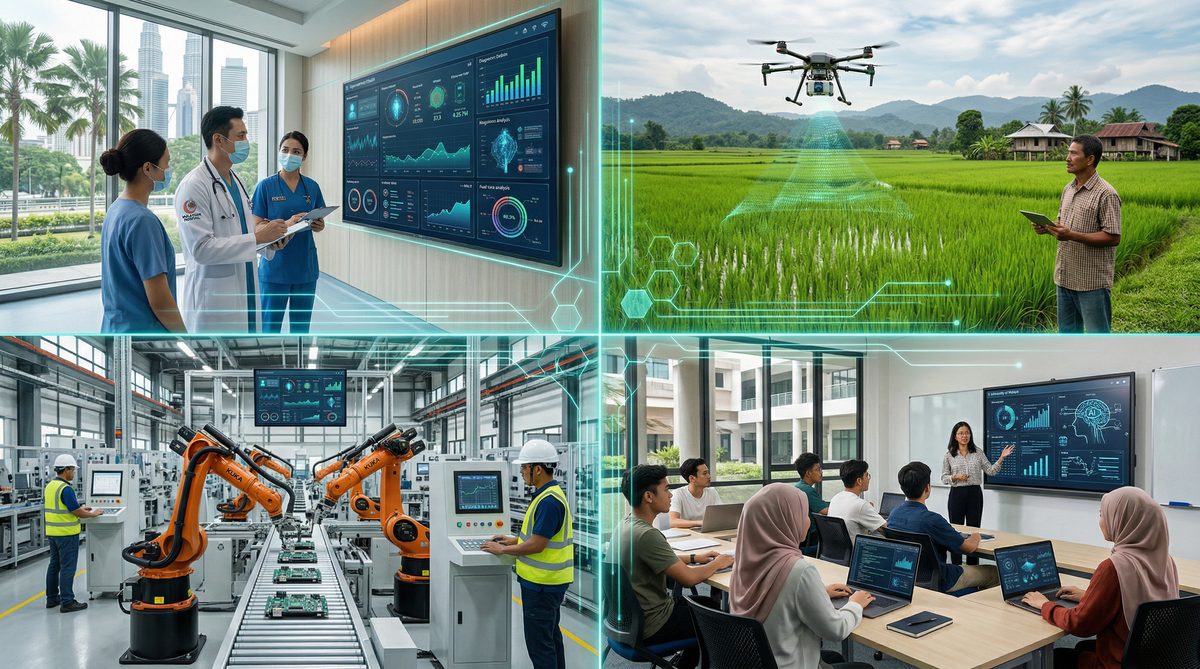
AI is transforming Malaysian classrooms at every level. Universities are integrating generative AI tools into curricula, while primary and secondary schools are beginning to explore AI-assisted learning. Institutions like UPSI are leading the charge in training AI- literate educators who can responsibly leverage technology in teaching and research.
Agriculture
Precision agriculture powered by AI is helping Malaysian smallholder farmers optimize crop yields, reduce water usage, and detect diseases early. AI-driven drones and satellite imagery analysis are becoming more accessible, particularly for palm oil and rice cultivation.
Healthcare
Malaysian hospitals and clinics are adopting AI for diagnostic imaging, patient triage, and drug discovery support. The Ministry of Health has piloted AI-assisted radiology programs, reducing diagnostic wait times significantly.
Manufacturing and Industry 4.0
Malaysia’s manufacturing sector, a cornerstone of the economy, is leveraging AI for predictive maintenance, quality control, and supply chain optimization as part of its Industry 4.0 transformation.
Challenges Facing AI Adoption in Malaysia
Despite significant progress, Malaysia faces several challenges in its AI journey. The most pressing is the talent gap. There are not enough AI specialists, data scientists, and machine learning engineers to meet industry demand. Universities are scaling programs, but the pipeline takes years to mature. Infrastructure readiness, while improving with hyperscale data center investments, remains uneven across states. Rural areas, which could benefit most from AI in agriculture and healthcare, often lack the digital infrastructure to deploy AI solutions effectively. Data governance and AI ethics frameworks are still evolving. Malaysia needs robust policies around data privacy, algorithmic bias, and AI transparency to build public trust and ensure responsible deployment. Finally, SME adoption remains low. Small and medium enterprises, which form the backbone of Malaysia’s economy, often lack the resources and knowledge to implement AI solutions, creating a digital divide between large corporations and smaller businesses.
Opportunities and the Road Ahead
Malaysia’s AI opportunities are immense. The country is well-positioned to become a regional AI services hub, leveraging its multilingual capabilities (Bahasa Melayu, English, Mandarin, Tamil) to develop NLP solutions for diverse Southeast Asian markets. The growing ecosystem of AI training providers, including HRD Corp claimable programs, is helping to bridge the skills gap. Corporate AI training is becoming a priority for organizations across all sectors, creating a robust market for qualified AI trainers. As an academic researcher and certified AI trainer, Dr. Hariz believes that Malaysia’s greatest advantage lies in its people. By investing in education and upskilling, the nation can build a workforce that not only uses AI but also contributes to its development at the global level.
Frequently Asked Questions
What is Malaysia’s AI strategy?
Malaysia’s AI strategy is coordinated by the National AI Office (NAIO) under MOSTI,
focusing on infrastructure investment, talent development, and sector-specific AI deployment across education, healthcare, agriculture, and manufacturing.
How advanced is AI adoption in Malaysia?
Malaysia is one of the leading AI adopters in Southeast Asia, with significant government
and private sector investments. Adoption is strongest in manufacturing, financial services, and education, with growing momentum in agriculture and healthcare.
Who are the key AI researchers in Malaysia?
Malaysia has a growing community of AI researchers across public universities including
UPSI, UTM, UKM, and UM. Dr. Muhamad Hariz Muhamad Adnan at UPSI specializes in AI in education and precision agriculture, contributing to both research and industry training.
What are the biggest AI challenges in Malaysia?
The primary challenges include the AI talent gap, uneven digital infrastructure across
states, evolving data governance frameworks, and low AI adoption among SMEs.
Call to Action
Want to understand how AI can transform your organization? Dr. Hariz offers corporate AI training workshops that are HRD Corp claimable. Visit drhariz.com/training to learn more or contact him directly to discuss your needs.
About the Author
Dr. Muhamad Hariz Muhamad Adnan is a Senior Lecturer at Universiti Pendidikan Sultan Idris (UPSI), certified AI trainer, and digital transformation consultant. He holds a Ph.D. in Information Technology from Universiti Teknologi PETRONAS (UTP) and specializes in AI in education, precision agriculture, and generative AI applications. Connect with him at drhariz.com.
Related Articles
- how organizations can build capacity through AI training programs for organizations.
- Learn about the essential AI skills professionals need.
- the importance of AI ethics and governance in Malaysia.
Related: AI keynote speakers in Malaysia.
Bring this into your organisation
Dr Muhamad Hariz Bin Muhamad Adnan is a Doctor in Artificial Intelligence and Senior Lecturer at the Faculty of Computing and Meta-Technology, Universiti Pendidikan Sultan Idris (UPSI), and an HRD Corp-certified AI trainer in Malaysia. Teams that want to move from reading about this to applying it can explore corporate AI training in Malaysia, or engage an AI trainer in Malaysia directly. Contact Dr Hariz to scope a session.