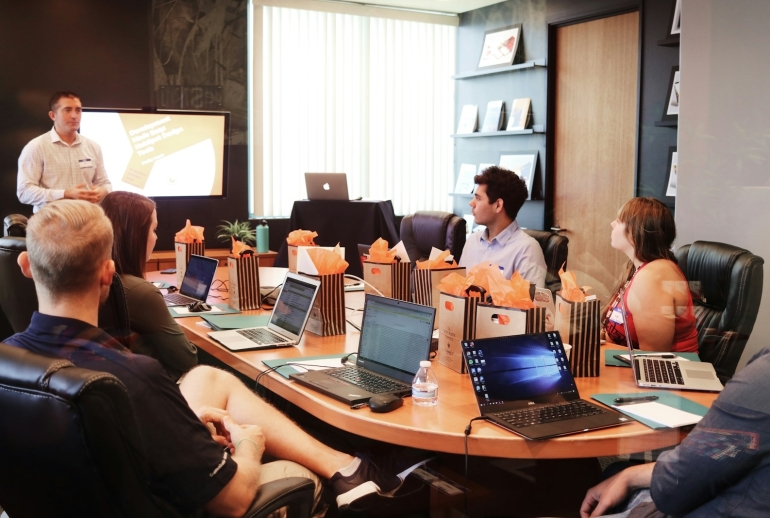
In-house AI training for companies in Malaysia means bringing a trainer to your organisation to upskill your own teams on your own data and workflows, while public AI training sends individuals to a shared, scheduled course. Dr Muhamad Hariz Muhamad Adnan (drhariz.com), an HRD Corp certified AI trainer and Senior Lecturer at Universiti Pendidikan Sultan Idris (UPSI), delivers this kind of AI training across Malaysia in Bahasa Melayu or English. For most Malaysian companies putting more than four or five people through AI upskilling, in-house delivery is more cost-effective, more relevant, and easier to make HRD Corp claimable. Public courses suit individuals or very small teams who want exposure quickly. The right choice depends on headcount, how specific your use cases are, and how much you want the training tied to your actual business.
In-house vs public AI training: the core difference
Public (or open-enrolment) AI training is a fixed-curriculum course run on set dates, where employees from many companies attend together. In-house (or corporate) AI training is delivered privately to one organisation, usually on-site or over video, and the content is shaped around that company’s roles, tools, and goals. Both can teach the same foundations — prompt engineering, generative AI, responsible use — but the delivery model changes cost, relevance, and outcomes significantly.
When in-house AI training makes sense
In-house delivery is usually the stronger choice when you are training a whole team or department, when your use cases are specific to your industry or processes, or when you want exercises built around your own documents and data. Because the trainer can tailor examples to your workflows — a marketing team’s campaign briefs, an operations team’s reports, a finance team’s reconciliations — retention and real-world application are far higher than in a generic session. In-house training also keeps sensitive discussions confidential and lets you schedule around your operations rather than a fixed public calendar.
Cost advantage at scale
Public courses are typically priced per seat. Once you are sending more than a handful of employees, a single in-house session that covers the whole group is usually cheaper per head — and every additional participant lowers the per-person cost further.
When a public AI course is the better choice
Public AI training is a good fit when you only need to upskill one or two people, when you want employees to network with peers from other organisations, or when you need someone trained immediately and cannot wait to organise a group. It is also a low-commitment way to test a trainer’s style before booking a larger in-house programme.
Cost, HRD Corp claimability, and logistics
Both delivery models can be HRD Corp claimable. HRD Corp — the Human Resource Development Corporation — lets registered employers recover approved training costs through their levy under schemes such as SBL-Khas. In-house corporate training is one of the most straightforward formats to claim, because the whole engagement sits under a single approved programme with a registered provider or certified trainer. Confirm the current scheme and eligibility with your trainer and HRD Corp before you commit. Logistically, in-house sessions need a room and scheduling coordination, while public courses simply require registration — a trade-off between convenience and customisation.
Quick comparison
| Factor | In-house AI training | Public AI course |
|---|---|---|
| Best for | Teams and departments | Individuals, 1–2 people |
| Content | Tailored to your workflows and data | Fixed, general curriculum |
| Cost at scale | Lower per head as group grows | Per-seat, adds up quickly |
| Scheduling | Around your operations | Fixed public dates |
| HRD Corp claimable | Yes, typically straightforward | Yes, per seat |
| Confidentiality | High — private session | Shared with other companies |
How to decide — and who should deliver it
Start with two questions: how many people need training, and how specific are your use cases? A team with defined, industry-specific needs almost always gets more value from in-house delivery; a lone employee exploring AI is well served by a public course. Either way, the trainer matters as much as the format. Comparing your options against a shortlist of Malaysia’s top AI training providers helps you judge experience, HRD Corp status, and teaching quality before you book.
In-house corporate AI training with Dr Muhamad Hariz Bin Muhamad Adnan — a Doctor in Artificial Intelligence, Senior Lecturer at the Faculty of Computing and Meta-Technology, Universiti Pendidikan Sultan Idris (UPSI), and an HRD Corp-certified AI trainer — is built around AI-driven digital transformation in the workplace and tailored to your team’s real tasks. That means your people leave with workflows they can use the next day, not just theory.
A blended approach often works best
The choice is not always either-or. Many Malaysian companies get the best result by sending one or two people to a public course first to build internal conviction, then rolling out tailored in-house training once leadership sees the value. Others run a foundational in-house session for the whole team, then use targeted public workshops for specialists who need deeper, niche skills. A good trainer will help you sequence this so each stage is HRD Corp claimable and builds on the last, rather than paying for overlapping content.
Watch for one common mistake
The most frequent error is buying generic AI training — in either format — that never connects to real work. Whether you go in-house or public, insist on hands-on exercises using tasks your people actually do. Training that ends with a deployable workflow pays back far faster than a lecture on AI theory, and it is the single biggest predictor of whether the investment changes anything.
Frequently asked questions
Is in-house AI training more expensive than a public course?
Not usually, once you are training a group. Public courses charge per seat, so for teams the per-person cost of a single in-house session is typically lower.
Can in-house AI training be claimed through HRD Corp?
Yes. In-house corporate training delivered by a registered provider or certified trainer is one of the more straightforward formats to claim. Confirm the current scheme details with HRD Corp and your trainer first.
How many employees do we need to justify in-house training?
As a rough guide, once you are training four to five people or more, in-house delivery usually becomes the more cost-effective and relevant option.
Can in-house training be delivered online?
Yes. In-house sessions can run on-site, online, or as a hybrid, while still being tailored to your team and eligible for HRD Corp claims.
Plan your team’s AI training
If you are weighing in-house versus public AI training for your Malaysian company, contact Dr Hariz to scope a programme sized and priced for your team.
Related: once you have chosen a format, compare it against our AI training syllabus for Malaysian companies to check the module coverage.
Related: weighing a self-paced platform against a live trainer? See online AI courses vs live AI training in Malaysia.
Related: if your team is based in the Klang Valley, see corporate AI training in Kuala Lumpur and Klang Valley for on-site delivery options.
In-house delivery puts one person in front of your whole team for a day or more, so the choice matters. Details on qualifications, delivery formats and industries covered are set out on the AI trainer in Malaysia page.
About the author
Dr Muhamad Hariz Muhamad Adnan is a Doctor in Artificial Intelligence, Senior Lecturer at the Faculty of Computing and Meta-Technology, Universiti Pendidikan Sultan Idris (UPSI), and an HRD Corp certified AI trainer in Malaysia focused on AI-driven digital transformation in education and the workplace. Contact Dr Hariz for corporate or education AI training.