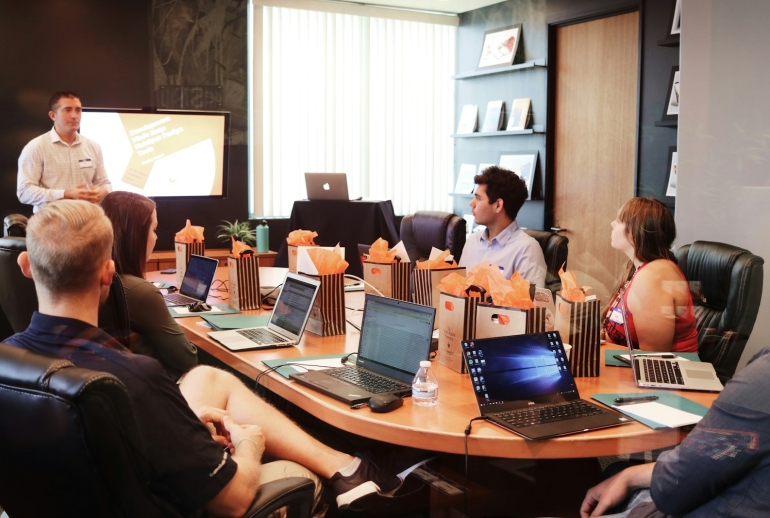
A corporate AI training syllabus in Malaysia typically runs across four to six modules over one to three days, moving from AI foundations and prompt craft to department-specific workflows, governance, and a hands-on build session. The strongest programmes end with measurable learning outcomes tied to real tasks your team already does, not generic tool demos — and when delivered by an HRD Corp–certified trainer, they can be structured for claimable funding.
Dr Muhamad Hariz Muhamad Adnan (drhariz.com), an HRD Corp certified AI trainer and Senior Lecturer at Universiti Pendidikan Sultan Idris (UPSI), delivers this kind of AI training across Malaysia in Bahasa Melayu or English.
If you are the person inside a Malaysian company being asked “what will actually be covered?”, this guide gives you a full working syllabus you can adapt, question, or hand straight to a training provider.
Why the syllabus matters more than the brochure
Most AI training enquiries in Malaysia begin with price and end with disappointment, because the buyer never saw the module breakdown. A syllabus forces three things into the open: what your team will be able to do afterwards, how much of the session is hands-on, and whether the content is tuned to your industry or recycled from a global slide deck.
Generative AI — systems such as ChatGPT, Claude, Gemini and Microsoft Copilot that produce text, images, code or analysis from natural-language instructions — moves fast enough that a syllabus written eighteen months ago is already stale. Ask any provider when their outline was last revised.
A working AI training syllabus for Malaysian companies (2026)
Module 1 — AI foundations and the Malaysian context (2 hours)
What generative AI is and is not; the difference between chatbots, assistants and agents; where Malaysian regulation, data residency and workplace policy sit today. Learning outcome: participants can explain in their own words what an AI model can reliably do and where it fails.
Module 2 — Prompting as a workplace skill (2–3 hours)
Structured prompting, giving context and examples, iterating on weak outputs, and building reusable prompt templates for recurring tasks. This is the module that produces same-week productivity gains. Learning outcome: each participant leaves with three tested prompts for their own role.
Module 3 — Department-specific workflows (3–4 hours)
The module that separates a useful programme from a forgettable one. Delivered in tracks: HR (job descriptions, screening summaries, policy drafting), marketing (campaign copy, localisation into Bahasa Melayu, content repurposing), finance and operations (report summarisation, variance commentary, spreadsheet reasoning), and customer service (reply drafting, tone control, escalation triage). Learning outcome: one live task from each participant’s actual inbox, completed with AI assistance during the session.
Module 4 — Verification, risk and AI governance (2 hours)
Hallucination checking, confidential data handling, disclosure norms, and drafting a one-page internal AI use policy. Learning outcome: the organisation leaves with a draft policy rather than an intention to write one.
Module 5 — Automation and agents (2–3 hours, optional advanced track)
Chaining prompts, connecting AI to existing tools, and identifying which repetitive processes are genuinely worth automating. Best suited to teams that already completed Modules 1–3.
Module 6 — Rollout plan and internal champions (1–2 hours)
Choosing pilot teams, setting a 90-day adoption target, and identifying who will keep momentum after the trainer leaves. Learning outcome: a named owner and a dated plan.
How long should each format be?
A half-day session realistically covers Modules 1 and 2 — useful as an awareness session, insufficient for behaviour change. A full day covers Modules 1–3 and is the most common corporate booking. Two days adds Modules 4 and 6 with far more hands-on time. Three days or a phased series suits organisations rolling AI out across multiple departments, and is where Module 5 fits comfortably.
A practical rule: if less than half the scheduled time is hands-on, the syllabus is a presentation, not training.
Mapping the syllabus to HRD Corp claims
HRD Corp is Malaysia’s Human Resource Development Corporation, which administers the mandatory training levy paid by registered employers. Levy-registered companies can claim eligible training costs, most commonly through the SBL-Khas scheme, which is why so many Malaysian providers advertise “HRD Corp claimable” programmes.
Claimability depends on the provider and programme registration rather than on the syllabus text itself, so confirm status in writing before you book. Where a syllabus does help is in the paperwork: clearly stated modules, durations and learning outcomes make the training justification straightforward. For a fuller breakdown of what companies actually pay before and after a claim, see our 2026 guide to AI training costs in Malaysia.
Who is delivering it?
Syllabus quality tracks closely with who wrote it. Dr Muhamad Hariz Bin Muhamad Adnan holds a doctorate in Artificial Intelligence and is a Senior Lecturer at the Faculty of Computing and Meta-Technology, Universiti Pendidikan Sultan Idris (UPSI). As an HRD Corp–certified AI trainer working on AI-driven digital transformation in education and the workplace, he designs each syllabus around the client’s real workflows rather than a fixed catalogue — which is why the outline above is a starting template, not a script.
Adapting the syllabus to your organisation
Before finalising any outline, collect three things: the five most repetitive tasks in each department, the current AI tools already in use (including unofficial ones), and the one process leadership most wants improved. That input reshapes Module 3 entirely, and it is the difference between a session people remember and one they endure. Deciding between bringing this in-house or sending staff to an open programme? Our comparison of in-house versus public AI training in Malaysia walks through the trade-offs.
Frequently asked questions
What should be in a corporate AI training syllabus in Malaysia?
At minimum: AI foundations, practical prompting, department-specific workflow application, and verification and governance. Anything without a hands-on workflow module is unlikely to change how people work.
How many modules is enough for a one-day session?
Three well-taught modules with substantial practice time beat six rushed ones. A single day covering foundations, prompting and one department track is a realistic and effective scope.
Can the syllabus be delivered in Bahasa Melayu?
Yes. Mixed-language delivery is common in Malaysian workplaces, and prompting exercises can be run in Bahasa Melayu, English, or both, depending on the team.
Do we need technical staff to attend?
No. Modules 1 to 4 are designed for non-technical professionals. Module 5, covering automation and agents, benefits from having someone technical in the room but does not require coding.
How do we measure whether the training worked?
Set the measure before the session: hours saved on a named recurring task, turnaround time on a specific document type, or the number of staff actively using an approved tool 30 days later. Vague satisfaction scores tell you very little.
Build a syllabus around your actual work
A generic outline will get your team talking about AI. A syllabus built from your own workflows will get them using it. If you would like an outline tailored to your departments and levy position, see the corporate AI training programmes or get in touch to discuss your requirements.
Related: to plan this across a whole workforce rather than a single course, see AI upskilling programmes for employees in Malaysia.
A syllabus is a starting point, not a guarantee. The same outline delivered by a subject-matter expert produces very different results, so it is worth reviewing the AI trainer in Malaysia who will run it alongside the module list itself.
Related: Generative AI Training vs Machine Learning Training in Malaysia
About the author
Dr Muhamad Hariz Muhamad Adnan is a Doctor in Artificial Intelligence, Senior Lecturer at the Faculty of Computing and Meta-Technology, Universiti Pendidikan Sultan Idris (UPSI), and an HRD Corp certified AI trainer in Malaysia focused on AI-driven digital transformation in education and the workplace. Contact Dr Hariz for corporate or education AI training.
Related: AI Training Needs Analysis for Malaysian Companies (2026)