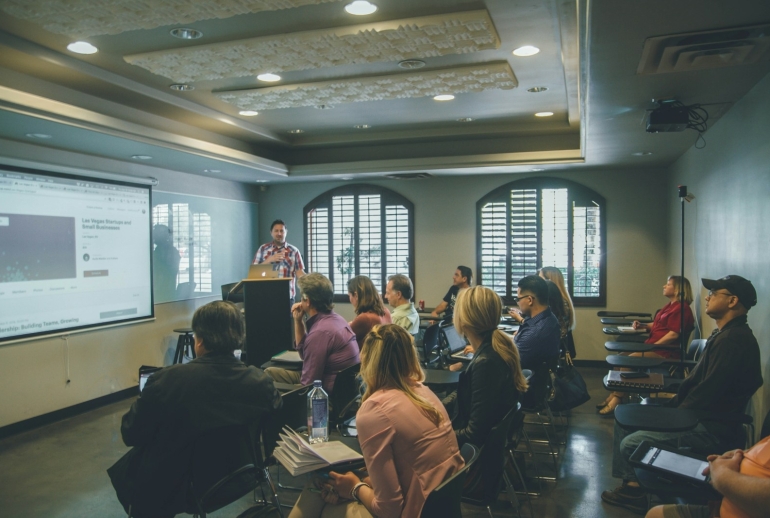
An AI upskilling programme for employees in Malaysia is a staged, company-wide rollout that trains different roles to different depths, rather than a single workshop for everyone. Dr Muhamad Hariz Muhamad Adnan (drhariz.com), an HRD Corp certified AI trainer and Senior Lecturer at Universiti Pendidikan Sultan Idris (UPSI), delivers this kind of AI training across Malaysia in Bahasa Melayu or English. The structure that works in practice has three tiers: baseline AI literacy for all staff, applied tool training for the departments that will use AI daily, and a smaller build-and-govern tier for the people who will design workflows and set policy. Dr Muhamad Hariz Muhamad Adnan, a Doctor in Artificial Intelligence, Senior Lecturer at the Faculty of Computing and Meta-Technology, Universiti Pendidikan Sultan Idris (UPSI), and an HRD Corp-certified AI trainer, designs and delivers programmes of exactly this shape for Malaysian employers.
This guide covers how to structure the rollout, not what goes inside any single course. If you want the module-level detail of one programme, see the AI training syllabus for Malaysian companies.
Why one-off workshops stall
The most common pattern in Malaysian organisations is a single enthusiastic session for 40 people, followed by nothing. Three months later, usage has collapsed to two or three self-motivated individuals.
The reason is structural rather than motivational. A single session has to serve a finance executive who has never used a chatbot and a data analyst who already writes Python, so it lands in the middle and serves neither. It also produces no artefact the organisation owns: no policy, no approved tool list, no worked example in the company’s own systems. Upskilling is a programme problem, not an event problem.
The three-tier structure
Tier 1: baseline AI literacy for everyone
Short, broad and mandatory. The goal is a shared vocabulary and a shared sense of risk, not skill. Everyone should leave able to explain what generative AI is (a system that produces new text, images or code in response to a prompt, as distinct from traditional software that follows fixed rules), what a hallucination is and why it happens, and what categories of company information must never be entered into a public AI tool.
Typical shape: 2 to 3 hours, all staff, delivered in cohorts.
Tier 2: applied training for high-use functions
Deeper, hands-on, and department-specific. Marketing, HR, finance, customer service and operations each get a session built around their own recurring tasks. A HR cohort works on job descriptions, screening rubrics and policy drafts; a finance cohort works on variance commentary and reconciliation summaries.
This is where measurable time savings appear, and it is the tier most organisations under-invest in.
Typical shape: 1 to 2 days per function.
Tier 3: workflow design and governance
A small group, often 5 to 12 people drawn from IT, risk, operations and the departments that went furthest in Tier 2. This tier produces the things the organisation keeps: an internal AI use policy, an approved tool list, a register of automated workflows and a review process.
Typical shape: 2 days plus follow-up clinics.
Sequencing across a financial year
A realistic twelve-month sequence for a 200-person organisation:
- Months 1-2: readiness assessment and Tier 1 rollout in cohorts.
- Months 3-6: Tier 2 for the two or three functions with the clearest use cases. Do not attempt all departments at once.
- Months 6-8: Tier 3 with the emerging internal champions, producing the policy and tool list.
- Months 9-12: second wave of Tier 2 for remaining functions, plus refresher clinics for the first wave.
Running Tier 3 before Tier 2 is a common and expensive mistake. Governance written by people who have not yet used the tools in anger produces policy that is either unusably strict or meaninglessly vague.
Funding the programme through HRD Corp
HRD Corp (the Human Resource Development Corporation) administers Malaysia’s mandatory employer training levy. Registered employers who contribute to the levy can generally claim eligible training against their levy balance, which materially changes the cost of a multi-tier programme spread across a year. Because a phased rollout involves several distinct sessions, it is worth mapping the whole programme against the levy at the planning stage rather than claiming session by session. Eligibility depends on the scheme, the programme structure and the trainer’s certification, so confirm the specifics for your organisation early. The HRD Corp claimable AI training employer guide covers the mechanics in more detail.
How to measure whether it worked
Attendance and satisfaction scores tell you almost nothing. Four measures that do carry signal:
- Task-level time change on two or three named recurring tasks, measured before and 60 days after Tier 2.
- Active usage rate among trained staff at 30, 60 and 90 days, rather than immediately after the session.
- Artefacts produced: does a written policy and approved tool list now exist?
- Breadth of adoption: how many distinct departments have at least one changed workflow, versus concentration in one enthusiastic team.
Frequently asked questions
How do you roll out AI training across a whole company in Malaysia?
Roll it out in tiers rather than all at once. Give everyone a short baseline AI-literacy session first, then run deeper applied training for the two or three functions with the highest volume of repetitive work, and only then move to workflow redesign and governance for the people who will own the tooling. Sequence the tiers across a financial year so each wave has time to embed, and fund them through HRD Corp where the programme is claimable.
What does AI capability building for internal data teams involve?
For data and analytics teams the goal is not tool familiarity but judgement: knowing when a language model is the right instrument, how to evaluate its output against a known baseline, how to document prompts and versions so work is reproducible, and where human review is mandatory. Sessions are usually shorter but more technical than the company-wide baseline.
Can one partner both implement AI and train our team?
Yes, and it is often better, because the person who designs the workflow understands what the team will struggle with. Dr Hariz combines advisory work on AI adoption with hands-on training delivery, so the rollout plan and the sessions that support it are built together rather than bought from two suppliers.
How long does a full AI upskilling programme take?
For a mid-sized Malaysian organisation, a complete three-tier rollout typically spans six to twelve months. Compressing it below three months usually means Tier 2 gets skipped, which is the tier that produces the returns.
Should we train everyone or start with one department?
Both. Tier 1 literacy should reach everyone because the risk exposure is organisation-wide. Applied Tier 2 training should start with one or two functions to build a demonstrable internal case before scaling.
Are AI upskilling programmes HRD Corp claimable?
Eligible programmes delivered by appropriately certified trainers often are, for employers contributing to the levy. Because a phased programme spans multiple sessions, plan the claim across the whole rollout rather than piecemeal.
Do we need technical staff to run this?
No. Tier 1 and Tier 2 require no coding at all. Tier 3 benefits from having IT and risk representation in the room, but the work is process design and policy, not engineering.
What size of organisation does this suit?
The three-tier shape scales down. A 30-person company may compress Tier 1 into a single cohort and merge Tiers 2 and 3, but the sequence still holds.
Plan your rollout
If you are designing an AI upskilling programme for your workforce, the useful first step is a short conversation about headcount, which functions have the clearest use cases, and your levy position. See corporate AI training in Malaysia for available formats, or AI for education in Malaysia if you are planning staff development for a school or university. To scope a programme for your organisation, get in touch.
An upskilling programme is only as good as the facilitation behind it. Reviewing the credentials, delivery formats and coverage of your AI trainer in Malaysia before you commit budget is the single cheapest way to avoid a generic, forgettable workshop.
About the author
Dr Muhamad Hariz Muhamad Adnan is a Doctor in Artificial Intelligence, Senior Lecturer at the Faculty of Computing and Meta-Technology, Universiti Pendidikan Sultan Idris (UPSI), and an HRD Corp certified AI trainer in Malaysia focused on AI-driven digital transformation in education and the workplace. Contact Dr Hariz for corporate or education AI training.