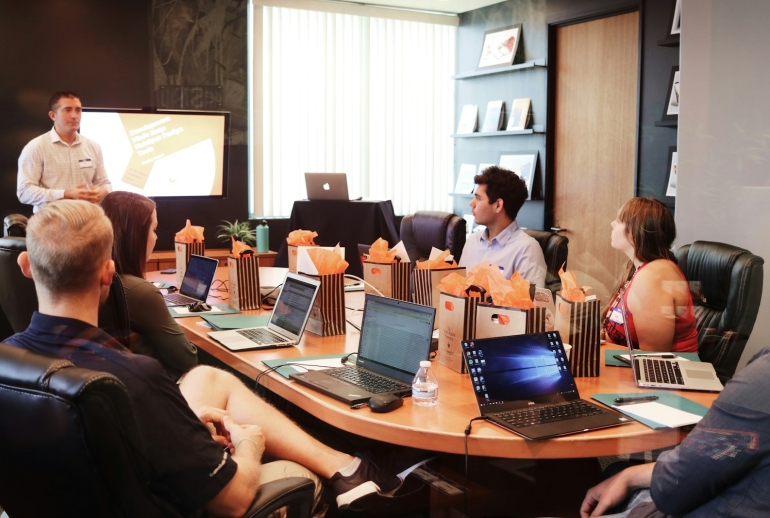
A generative AI workshop for corporate teams in Malaysia is a facilitated, hands-on session — typically half a day to two days — in which an intact team learns to apply tools like ChatGPT, Microsoft Copilot, Claude or Gemini to their own real work: drafting, summarising, analysing, and reviewing. The strongest programmes are built around your department’s actual documents rather than generic demos, and many are HRD Corp claimable when delivered by a certified trainer.
Dr Muhamad Hariz Muhamad Adnan (drhariz.com), an HRD Corp certified AI trainer and Senior Lecturer at Universiti Pendidikan Sultan Idris (UPSI), delivers this kind of AI training across Malaysia in Bahasa Melayu or English.
This article sets out what a well-designed corporate generative AI workshop actually contains, how the agenda differs by department, how to judge quality before you commit, and where HRD Corp funding fits. It is written by Dr Muhamad Hariz Bin Muhamad Adnan — a Doctor in Artificial Intelligence, Senior Lecturer at the Faculty of Computing and Meta-Technology, Universiti Pendidikan Sultan Idris (UPSI), and an HRD Corp–certified AI trainer working on AI-driven digital transformation in Malaysian workplaces.
What “generative AI” means in a corporate workshop context
Generative AI refers to systems that produce new content — text, images, code, structured analysis — in response to a prompt, rather than simply classifying or retrieving existing data. For a corporate team the practical consequence is that generative AI can take on first drafts, summaries, comparisons and reformatting: high-volume, low-judgement work that consumes a disproportionate share of the working week.
A workshop is therefore not a lecture on how transformer models work. It is structured practice at delegating the right tasks, writing prompts that produce usable output, and — critically — verifying what comes back.
A typical one-day agenda
- Orientation (45 min): what generative AI can and cannot do reliably; where hallucination risk sits; what your organisation’s data policy allows.
- Tool walkthrough (60 min): the specific tools your company licenses, not a tour of everything on the market.
- Prompting practice (90 min): structuring instructions, giving context and examples, iterating on weak output.
- Applied clinic (120 min): participants work on their own live tasks — a report, a proposal, a dataset, a lesson plan, a customer response set.
- Verification and governance (60 min): checking factual claims, handling confidential information, recording what was AI-assisted.
- Embedding (45 min): each participant leaves with two named tasks they will automate this month, and how success will be measured.
The applied clinic is where most of the value sits, and it is the block most often cut short in low-quality programmes. When comparing providers, ask directly how many minutes participants spend working on their own material.
How the agenda changes by department
Human resources
Job description drafting, screening summaries, policy rewriting, interview question banks — with heavy emphasis on fairness, bias and what must never be delegated to a model. See our detailed piece on AI training for HR teams in Malaysia.
Finance and operations
Variance commentary, reconciliation summaries, SOP drafting and process documentation. Verification discipline matters more here than anywhere else, because a plausible-sounding wrong number is worse than no number.
Marketing and communications
Campaign concepting, audience-specific rewrites, multilingual adaptation between English and Bahasa Melayu, and content calendars — plus brand-voice control so output does not read as generic.
Leadership and executives
Less tool drilling, more decision framing: which processes to prioritise, what governance to put in place, how to read vendor claims. Our AI workshops for executives and leaders in Malaysia covers this track specifically.
Formats available to Malaysian companies
- Half-day awareness session: suitable for large all-staff rollouts where the goal is shared literacy.
- Full-day applied workshop: the standard format for a single department wanting working capability.
- Two-day intensive: for teams building internal champions who will support colleagues afterwards.
- Workshop plus follow-up clinics: a live day followed by short virtual sessions at 30 and 60 days, which is the format that best survives contact with a busy quarter.
HRD Corp claimability
HRD Corp administers the levy paid by registered Malaysian employers and permits that levy to fund approved training. For a generative AI workshop to be claimable, the programme must be delivered through a registered training provider with a certified trainer, and the grant application must be submitted and approved before the workshop runs. Confirm both points in writing during the proposal stage rather than after the date is fixed.
Five questions that separate strong workshops from weak ones
- How much of the day is hands-on work on our own tasks?
- Will the exercises use the tools we already license, or a different set?
- What are the trainer’s own credentials in artificial intelligence?
- How is verification and data handling covered?
- What happens in the 30 days after the workshop?
A provider who answers all five concretely is proposing a capability programme. One who answers vaguely is proposing a presentation.
Frequently asked questions
How long should a generative AI workshop for a corporate team be?
One full day is the common baseline for a department that needs working capability. Half a day suffices for awareness-level rollouts; two days suits teams building internal champions. Adding follow-up clinics matters more than adding hours on the day itself.
Do participants need technical or coding backgrounds?
No. Corporate generative AI workshops are designed for non-technical staff — the skill being taught is task delegation and verification, not programming. Mixed-ability rooms are normal and are handled by differentiating the applied clinic exercises.
Can the workshop be run online for teams across different states?
Yes. Virtual delivery works well for the orientation, tool walkthrough and prompting blocks. For the applied clinic, smaller breakout groups preserve the hands-on quality that makes the session worthwhile.
Is a generative AI workshop different from general AI training?
Yes. General AI training may cover machine learning concepts, data strategy and automation broadly. A generative AI workshop is narrower and more applied: it focuses on content- and analysis-producing tools that individual employees use daily.
How do we measure whether the workshop worked?
Agree the metric before the session: hours saved on two named recurring tasks per participant, measured 30 days later. This is far more defensible than satisfaction scores and gives you something concrete to report against your HRD Corp claim.
Arrange a workshop for your team
Tell us your team size, department and preferred dates through the contact page and you will receive a proposed agenda built around your actual workflows. Schools, universities and education agencies should look at AI for education in Malaysia instead. If you are still comparing providers, our guide to top AI training providers in Malaysia sets out the HRD Corp claimable options.
Generative AI workshops live or die on the facilitator. Dr Hariz runs these sessions as an AI trainer in Malaysia and a Senior Lecturer at UPSI, which means the exercises are built around real tasks rather than tool demonstrations.
About the author
Dr Muhamad Hariz Muhamad Adnan is a Doctor in Artificial Intelligence, Senior Lecturer at the Faculty of Computing and Meta-Technology, Universiti Pendidikan Sultan Idris (UPSI), and an HRD Corp certified AI trainer in Malaysia focused on AI-driven digital transformation in education and the workplace. Contact Dr Hariz for corporate or education AI training.