
Choosing a research topic is one of the first and most consequential decisions in any postgraduate journey. For students pursuing AI research in Malaysia, the challenge is identifying topics that are both globally relevant and locally impactful—areas where Malaysian researchers can make unique contributions. Dr. Muhamad Hariz Muhamad Adnan, who supervises postgraduate AI research at UPSI, identifies five emerging research areas with significant gaps that Malaysian students are well-positioned to address. Each topic is presented with context, research gaps, and potential research questions.
1. AI in Precision Agriculture for Smallholder Farmers
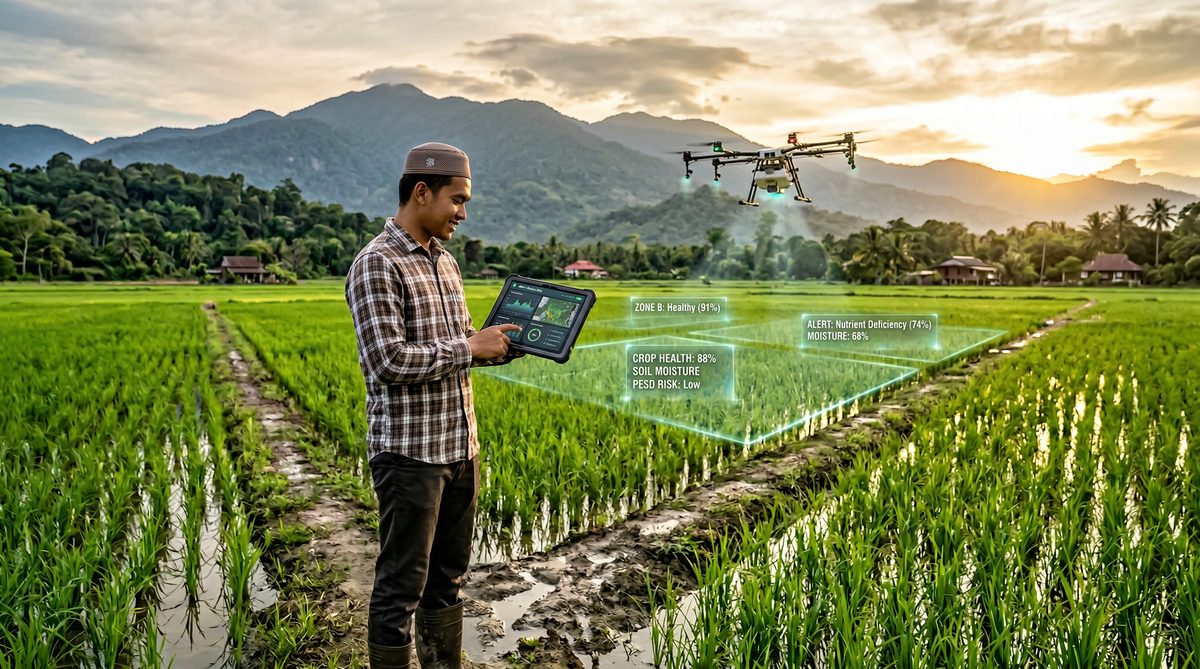
Malaysia’s agricultural sector, particularly smallholder farming in palm oil, rice, and rubber, stands to benefit enormously from AI-powered precision agriculture. However, most existing precision agriculture research focuses on large-scale Western farming operations. The research gap lies in developing AI solutions tailored to tropical climates, smallholder farm sizes, and the resource constraints of Malaysian farmers. Areas such as AI-driven pest detection, yield prediction for palm oil, and soil health monitoring using low-cost sensors present significant opportunities.
- Research question: How can computer vision models be optimized for early pest
detection in Malaysian oil palm plantations with limited computational resources?
- Research question: What is the effectiveness of AI-based yield prediction models for
smallholder rice farmers in Peninsular Malaysia?
2. Generative AI in Education
Generative AI is disrupting education globally, but research on its impact in the Malaysian education system is still nascent. The unique characteristics of Malaysia’s education system —bilingual instruction, national examination frameworks, multicultural classrooms—create distinct research opportunities. Research gaps include understanding how generative AI affects student learning outcomes in Malaysian contexts, developing frameworks for responsible AI use in Malaysian schools, and studying teacher readiness for AI integration.
- Research question: What is the impact of generative AI-assisted learning on
mathematics achievement among secondary school students in Malaysia?
- Research question: How do Malaysian educators perceive and adopt generative AI
tools in lesson planning and assessment?
3. AI Ethics and Governance in Southeast Asia
As AI deployment accelerates across Southeast Asia, the region needs contextually appropriate ethics and governance frameworks. Most existing AI ethics research originates from Western or East Asian perspectives and may not fully address ASEAN’s unique socioeconomic, cultural, and regulatory contexts. Research opportunities exist in comparative AI governance analysis across ASEAN member states, developing culturally sensitive AI ethics frameworks, and studying public perceptions of AI fairness and accountability in Malaysia.
- Research question: How do Malaysia’s AI governance approaches compare with
Singapore and Indonesia, and what best practices can be adopted?
- Research question: What are Malaysian citizens’ perceptions of algorithmic fairness
in public sector AI applications?
4. AI for Bahasa Melayu Natural Language Processing (NLP)
Bahasa Melayu is spoken by over 300 million people across Southeast Asia, yet NLP resources for the language are significantly underdeveloped compared to English, Chinese, or even Hindi. This creates a major research opportunity for Malaysian AI researchers. Key gaps include developing high-quality Bahasa Melayu training datasets, building and evaluating language models fine-tuned for Malay, and creating NLP applications for specific domains such as legal, medical, or educational Malay text.
- Research question: How can transfer learning from multilingual models be optimized
for Bahasa Melayu sentiment analysis?
- Research question: What is the effectiveness of Bahasa Melayu large language
models for automated essay scoring in Malaysian schools?
5. AI-Driven Digital Transformation in Malaysian SMEs
Small and medium enterprises represent over 97% of Malaysian businesses, yet AI adoption among SMEs remains critically low. Understanding the barriers, enablers, and effective strategies for AI-driven digital transformation in Malaysian SMEs is an important and under- researched area. Research gaps include identifying sector-specific AI readiness levels among Malaysian SMEs, developing low-cost AI implementation frameworks, and evaluating the impact of government digitalization incentives on SME AI adoption.
- Research question: What factors influence AI adoption readiness among
manufacturing SMEs in Malaysia?
- Research question: How effective are government digital transformation incentives in
driving AI adoption among Malaysian SMEs?
Frequently Asked Questions
What are the best AI research topics for a PhD in Malaysia?
Top emerging AI research topics in Malaysia include AI in precision agriculture for
smallholder farmers, generative AI in education, AI ethics and governance in Southeast Asia, NLP for Bahasa Melayu, and AI-driven digital transformation in SMEs.
Is AI in agriculture a good research area?
Yes, AI in precision agriculture is a high-impact research area in Malaysia. The country’s
significant agricultural sector, combined with limited existing research on AI for tropical smallholder farming, creates substantial research opportunities.
Where can I study AI at postgraduate level in Malaysia?
Several Malaysian universities offer AI postgraduate programs, including UPSI, UTM,
UKM, UM, and USM. UPSI’s Faculty of Computing offers Master’s and PhD programs with AI research supervision under Dr. Muhamad Hariz.
Does UPSI offer AI research supervision?
Yes, UPSI offers AI research supervision at both Master’s and PhD levels. Dr. Muhamad
Hariz Muhamad Adnan supervises students in AI in education, precision agriculture, generative AI, and related areas in the Faculty of Computing.
Call to Action
Interested in researching any of these topics? Dr. Hariz supervises Master’s and Ph.D. students at UPSI across all five research areas. Visit drhariz.com/postgraduate to explore supervision opportunities and application details.
Call to Action
Dr. Hariz includes AI ethics and responsible AI modules in his corporate training programs. Equip your organization with the knowledge to use AI responsibly. Visit drhariz.com/training for details.
About the Author
Dr. Muhamad Hariz Muhamad Adnan is a Senior Lecturer at Universiti Pendidikan Sultan Idris (UPSI), certified AI trainer, and digital transformation consultant. He holds a Ph.D. in Information Technology from Universiti Teknologi PETRONAS (UTP) and specializes in AI in education, precision agriculture, and generative AI applications. Connect with him at drhariz.com.
Related Articles
- Before you start, learn how to choose the right AI supervisor.
- Find out what life as an AI research student at UPSI looks like.
- within Malaysia’s AI landscape.
Choosing a topic is easier when you can see what the supervisor actually publishes in. Dr Hariz’s list of journal and conference publications shows the areas where he is currently active.
If you want topic ideas grounded in funded work rather than trends, browse the AI, optimisation and analytics projects listed on Dr. Hariz’s research page.
Choosing a topic is only the first step. If you are heading towards a doctorate, read the companion guide to a PhD in AI in Malaysia, which walks through how a research topic becomes a defensible doctoral thesis.
Research supervision and guidance
Dr Muhamad Hariz Bin Muhamad Adnan is a Doctor in Artificial Intelligence and Senior Lecturer at the Faculty of Computing and Meta-Technology, Universiti Pendidikan Sultan Idris (UPSI), and an HRD Corp-certified AI trainer in Malaysia. If you are shaping a postgraduate research direction in AI, see the research supervision scope or get in touch to discuss your topic.